Live context
Quick facts
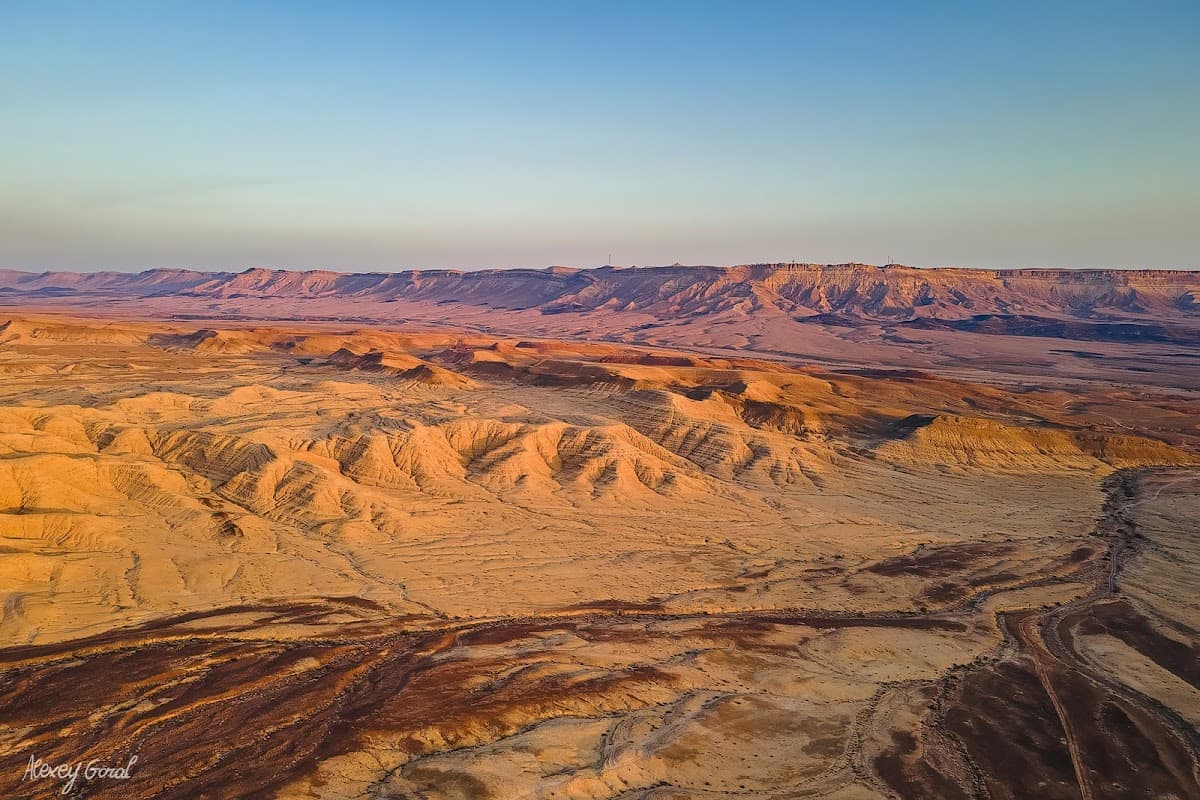
- The Ramon Crater, or Makhtesh Ramon, is the largest erosion crater in the world, stretching approximately 40 kilometers in length and 10 kilometers in width.
- The Negev desert covers more than half of Israel's land area, accounting for about 60% of the country's total landmass.
- Home to unique geological formations, the Ramon Crater contains rock layers that date back over 200 million years, showcasing a rich geological history.
- The area is recognized as one of the best stargazing sites globally, with minimal light pollution, making it possible to see thousands of stars and celestial events clearly.
- Ramon Crater's diverse ecosystem includes over 100 species of flora and fauna, some of which are endemic to the region, including the Nubian ibex and the desert fox.
Travel details
- Country
- Israel
- Wind (now)
- 16 km/h
- Coordinates
- 30.6102, 34.8019
Share this destination
Share Negev & Ramon Crater, Israel with friends or save it for later.
Want to embed this destination on your site?
Get embed code →Related destinations
🇮🇱
Timna Park, Israel
Ancient copper mines and surreal sandstone formations—Solomon’s Pillars, natural arches, and desert color—set in the Arava south of Eilat.
🇮🇱
Ein Gedi Nature Reserve, Israel
A desert oasis where waterfalls spill into shaded pools above the Dead Sea, ibex cling to cliffs, and David’s waterfall trail cools the Judean heat.
🇮🇱
Eilat & Red Sea, Israel
A desert resort city where coral reefs teem with marine life in the Red Sea, desert mountains meet turquoise waters, and year-round sunshine creates an oasis of relaxation and adventure.
🇮🇱
Dead Sea & Masada, Israel
The lowest place on Earth meets a desert fortress: float in hypersaline water, then climb or cable-car to Masada for sunrise over the Judean wilderness.